
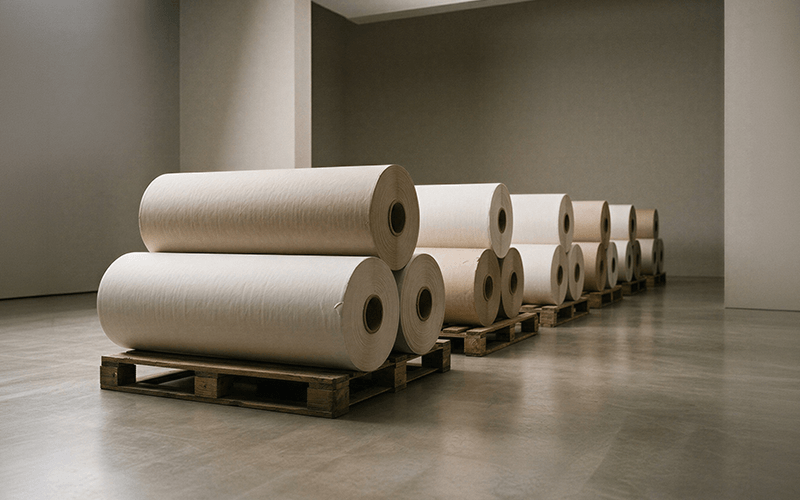
Sulfite paper is among the most durable and natural products in the packaging world. Professional sulfite paper production is entirely powered by a sustainable cycle. First, manufacturers obtain the raw material from pine, spruce, and beech trees in ecological forests. In particular, the strong fibers of these trees form the foundation of a high-quality structure.
Teams harvest matured trees in a controlled manner. Furthermore, to protect nature, they plant new saplings to replace every harvested tree. In this way, they successfully maintain the continuity of forests and the ecological balance. The raw material flow required for sulfite paper moves forward through these sustainable methods. Consequently, this nature-respecting process strengthens the product’s eco-friendly identity.
Factories first meticulously separate the harvested tree trunks from their bark. Then, they chop these trunks in machines to turn them into small wood chips. This process uncovers the valuable cellulose fibers. Specifically, these fibers are the primary ingredient of sulfite paper production. Therefore, the quality of the fibers is of vital importance for the paper’s tear resistance and surface smoothness.
Manufacturers convert wood chips into cellulose pulp in specialized high-pressure vessels. The chemical method applied at this stage purifies the fibers by separating them from one another. Thus, we obtain a clean and highly strong cellulose pulp for sulfite paper production. Afterward, the pulp takes on a new form according to its degree of whiteness and softness.
Advanced machines mix cellulose fibers with water. Next, they spread them onto wires in a thin layer. Then, intense pressing and high-temperature drying processes begin. This process tightly binds the fibers to one another. As a result, the emerging durable material adapts perfectly to printing processes with its smooth surface.
At the end of production, experts meticulously check the paper’s durability and printing quality. Subsequently, we slice the large rolls into the required dimensions and send them to the packaging sector. This paper product provides reliability especially in food packaging and bakery products.
Moreover, it is ideal for textile interlining paper. For more information regarding international sectoral standards, you can visit the ISO Official Website. In addition, you can also take a look at our internal packaging paper solutions used alongside these products.